Shopping cart

Hair Transplant in Jaipur | Dr. Dhabhai’s Skin Clinic

  • Home
  • Hair Transplant in Jaipur | Dr. Dhabhai’s Skin Clinic


Dermatologist-Planned Hair Restoration

Hair Transplant in Jaipur

Losing hair rarely feels like a small thing. A hairline that keeps creeping backwards, a crown that shows through under bright light, or hair that simply will not grow back can change how you feel in photographs, in meetings, and in the mirror.

If you are researching a hair transplant in Jaipur, the first question worth answering is not “how many grafts?” but “what is actually causing this?” At Dr. Dhabhai’s Skin Clinic, that question comes first. Dr. Ravindra Dhabhai, a qualified dermatologist and dermatosurgeon, examines your scalp, reviews your history, and studies your donor area before any surgical plan is discussed.

The aim is not to place the maximum number of follicles. It is to build a restoration plan that suits your face, your age, your pattern of loss, and the hair you still have.

✨ Why Choose Dr. Dhabhai’s Clinic?

Dermatologist-Led Hair & Scalp Specialist

👨‍⚕️
Qualified Dermatosurgeon
MD Dermatologist with specialist exposure from Nanavati Hospital, Mumbai

🔍
Diagnostic First Approach
Personalised scalp, density & donor evaluation before any surgery

📍
CLINIC LOCATION
Dr. Dhabhai’s Skin Clinic
Above ICICI Bank, 1st Floor, Girdhar Marg, Malviya Nagar, Jaipur, Rajasthan 302017
🗺️ Get Directions on Google Maps ➔


📞 Call +91 97727 60561

Surgical Fundamentals

What a Hair Transplant Involves

A hair transplant relocates healthy follicles from a donor zone — usually the back or sides of the scalp, where hair tends to be more resistant to pattern loss — into regions that have thinned or gone bald.

Nothing artificial is added. Every follicle placed on your scalp is already yours. That is precisely why the technical details matter so much: how gently each unit is harvested, how it is stored and prepared, the depth it is placed at, and the angle and direction it is set in all shape whether the final result reads as natural or as obviously “done”.

At Dr. Dhabhai’s Skin Clinic, no one is booked for surgery on the strength of a phone enquiry. Every patient considering a hair transplant in Jaipur is examined in person, with the extent and likely cause of hair loss, donor density and quality, scalp condition, and personal expectations all reviewed before the procedure is recommended.

⚠️ Not All Hair Loss Needs Surgery

This is worth stating plainly, because it is often left unsaid. Surgery treats one kind of problem: permanent, patterned loss with a reliable donor supply. It does not treat everything that makes hair fall.

Shedding driven by iron or vitamin deficiency, thyroid or hormonal imbalance, post-illness or post-pregnancy telogen effluvium, scalp inflammation, seborrhoeic dermatitis, fungal infection, or significant stress may respond to medical treatment — and transplanting into an actively inflamed or medically unstable scalp is rarely the right first move.

A dermatologist-led consultation separates these possibilities from true pattern baldness. Sometimes the honest recommendation is medical therapy, and sometimes it is a combination of medical management now and transplantation later.

Patient Assessment

Who May Be a Candidate?

Transplantation is generally discussed with patients experiencing:

Male pattern baldness at various stages
A hairline receded at front/corners
Thinning across the temples
Loss over the crown or vertex
Steadily progressing patterned baldness
Selected female pattern thinning cases
Scarring or post-injury hair loss
Earlier transplant needing refinement

Suitability is never decided from a photograph alone. Donor density, hair calibre, scalp laxity, general health, age, and stability of loss all feed into the decision.

🔬

FUE Hair Transplant

Follicular Unit Extraction (FUE) is among the most widely performed hair transplant techniques today. Rather than removing a strip of scalp, the surgeon extracts follicular units individually using fine punches, leaving small, scattered extraction points across the donor zone.

Those units are then examined, prepared, and implanted into the recipient area following the plan agreed at consultation.

FUE suits many patients, but it is not automatically the answer for every case. How many grafts your scalp needs — and how many your donor area can safely spare without looking depleted — depends entirely on your own pattern of loss. Donor supply is finite, and a good plan protects it for the future rather than exhausting it in a single sitting.

📐

Designing a Hairline That Ages Well

Filling a bald patch is the easy part. Designing a hairline that still looks right ten years from now is the skill.

A hairline placed too low or too straight may look impressive at twenty-eight and distinctly odd at forty-five, particularly once the hair behind it thins further. Planning therefore accounts for:

  • Current hairline position and recession extent
  • Age, family history, and future loss direction
  • Facial proportions, forehead height, and balance
  • Natural angle, direction, and swirl of existing hair
  • Realistic donor density for front, mid-scalp & crown
  • Preserving donor follicles for future sessions

A well-planned hairline should look unremarkable — in the best possible sense. It should simply look like hair that belongs on your head.

Surgical Workflow

The Procedure, Step by Step

1

Scalp and hair evaluation

Your pattern of loss, scalp health, medical and family history, existing density, and donor area are assessed in detail.

2

Treatment planning

If transplantation is appropriate, the recipient zones, donor area, and expected graft requirement are mapped out and discussed with you.

3

Hairline design

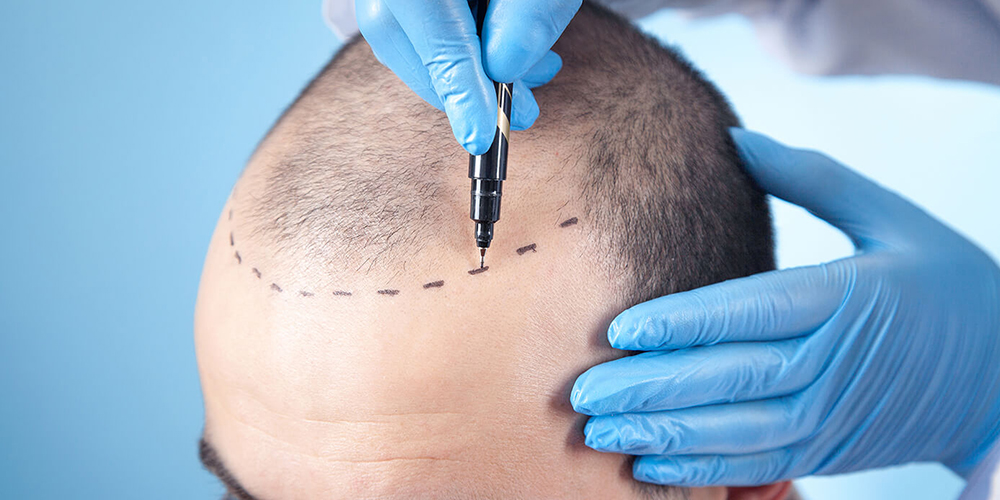
For frontal restoration, the proposed line is drawn and reviewed against your facial proportions, age, existing hair, and donor availability.

4

Follicle harvesting

Grafts are extracted from the planned donor zone using the agreed technique, under local anaesthesia.

5

Graft preparation

The harvested follicular units are inspected and prepared for placement, with careful handling to protect them.

6

Implantation

Follicles are placed into the recipient area, matching the angle, direction, distribution, and density of the hair around them.

7

Aftercare and review

You leave with clear instructions on washing, scalp care, activity restrictions, prescribed medication, and scheduled follow-up visits.

Post-Operative Progress

Recovery and the Growth Timeline

Results from a hair transplant arrive slowly. Anyone promising a finished look in a few weeks is not describing how follicles behave.

During the first days you may notice mild redness, some swelling, small crusts around the implanted grafts, and temporary sensitivity or tightness. These settle progressively.

Then comes the phase that surprises patients most: the transplanted hair shafts shed. This is expected. The shaft falls; the follicle stays anchored beneath the scalp and begins a fresh growth cycle.

New growth emerges gradually over the following months, thickening and maturing over a considerably longer period. Your own timeline will depend on how much loss you started with, your donor quality, scalp condition, the technique used, your general health, and — not least — how closely you follow the aftercare instructions.

Your doctor will explain what a realistic outcome looks like for your specific scalp, rather than for a photograph of someone else’s.

Patient Trust

Why Patients Choose Dr. Dhabhai’s Skin Clinic

The assessment is medical, not commercial

Hair loss has many causes, and not all of them are surgical. Evaluation by a dermatologist establishes whether transplantation, medical management, or a staged combination of both makes sense in your case.

Plans are built around one scalp — yours

Graft numbers, priority zones, and technique are decided from your pattern of loss, donor supply, current density, age, scalp condition, and what you actually want to achieve.

Natural appearance is the benchmark

Hairline design and follicle placement follow the direction, angle, and distribution of your existing hair, so the restored area blends rather than announces itself.

A full range of hair and scalp treatment

Depending on your diagnosis, care may involve medical therapy, GFC treatment, transplantation, or another dermatologist-recommended approach — alone or in sequence.

Easy to reach in Jaipur

The clinic is located in Malviya Nagar, Jaipur, keeping consultations and the follow-up visits that matter after surgery convenient for patients across the city and nearby areas.

Doctor Profile

About Dr. Ravindra Dhabhai

Dr. Ravindra Dhabhai is an MD dermatologist whose practice spans clinical dermatology, dermatosurgery, laser treatment, and aesthetic dermatology.

He completed his MBBS at Sardar Patel Medical College, Bikaner, followed by his MD at Sampurnanand Medical College, Jodhpur, and subsequently gained further dermatosurgical exposure at Nanavati Hospital, Mumbai.

His approach to hair loss is diagnostic before it is procedural: understand what is driving the loss and how far it has progressed, then recommend the management or restoration plan that fits.

Pricing Transparency

Hair Transplant Cost in Jaipur

No clinic can quote an accurate figure without examining your scalp. Any number given before that is a guess dressed up as a price.

What the final cost depends on:

• How extensive balding or thinning currently is
• Number of grafts or follicular units required
• Size of the area being restored
• Donor density and safe harvest limit
• Complexity of hairline restoration
• Technique recommended for your case
• Whether supporting treatment is needed

It is tempting to shop on price alone. A more useful comparison is what the plan actually contains: estimated graft requirement, donor management, expected results, surgical team, and follow-up care. A cheap transplant that depletes your donor area or leaves an unnatural hairline is expensive in every way that matters.

Book a consultation for an individual assessment and a treatment recommendation based on your scalp.

Patient Clarity

Frequently Asked Questions

Is a hair transplant permanent?

The follicles chosen for transplantation are generally taken from zones that resist pattern loss, so transplanted hair tends to be lasting. What continues is the natural thinning of your surrounding, non-transplanted hair — which is why your dermatologist may advise ongoing medical management alongside surgery.

Does it hurt?

The procedure is performed under local anaesthesia, so the scalp is numbed throughout. Afterwards, some soreness, tightness, swelling, or sensitivity during the recovery days is common and temporary.

When will I see new hair?

Not immediately. Transplanted shafts commonly shed in the early weeks before the follicles restart their growth cycle. Visible improvement builds progressively over several months, with the fuller result appearing later still. The precise timeline varies from person to person.

How many grafts will I need?

There is no standard number. It depends on the size of the area being covered, the density you are aiming for, your donor supply, your hair calibre and characteristics, and the long-term plan. A scalp examination is the only reliable way to estimate it.

Can women have a hair transplant?

Some can. Women with a stable pattern of permanent loss and an adequate donor area may be suitable candidates. Because female hair loss frequently has underlying medical or hormonal causes, thorough assessment beforehand is especially important.

Will it fix a receding hairline?

A receding front or temple recession can often be addressed, provided you are a suitable candidate. The design must take your age, facial proportions, existing hair, donor availability, and likely future recession into account — otherwise the new hairline can look out of place as time passes.

Do I also need PRP or GFC?

Not automatically. Supportive treatments such as PRP, GFC, or medical therapy are recommended selectively, based on your scalp condition and the nature of your hair loss — not applied to everyone as a package.

How do I know if I am suitable?

Suitability rests on the cause and stability of your loss, donor quality, scalp health, general health, age, expectations, and how much coverage you want. An in-person consultation remains the only dependable way to answer this.

Take the First Step

If a receding hairline, a thinning crown, or steadily widening bald patches have been on your mind, a proper evaluation will tell you where you stand — and what can realistically be done about it.

Consult Dr. Ravindra Dhabhai at Dr. Dhabhai’s Skin Clinic for an individual assessment and find out whether a hair transplant in Jaipur is the right option for you.

📍 Dr. Dhabhai’s Skin Clinic
Above ICICI Bank, 1st Floor, Girdhar Marg, Malviya Nagar, Jaipur, Rajasthan 302017