

HAIR & SCALP / PATIENT GUIDE
Which Hormone Causes Hair Loss in Females? PCOS, Thyroid & Menopause Explained
See how androgens, PCOS, thyroid changes, menopause and postpartum shifts can affect women’s hair and what a scalp assessment may involve.

UNDERSTAND THE PATTERN
What changed before shedding started?
Timing, symptoms and the pattern of thinning help narrow down possible causes.
THE SHORT ANSWER
Several hormone changes can affect the hair cycle.
A wider part and sudden shedding can have different causes. Your symptoms and scalp examination help guide testing and treatment.
Seeing more hair than usual in your brush can be scary. Most women first blame the shampoo, a stressful month, or something missing from their diet. Sometimes that’s right. But often the real reason is your hormones.
PCOS, thyroid problems, menopause and the months after having a baby can all throw your hair growth cycle off balance. The result is more shedding, a thinner ponytail, and less volume than you’re used to.
So, which hormone causes hair loss in females? There isn’t one single culprit. Androgens (especially dihydrotestosterone, or DHT), thyroid hormones and estrogen can all play a part. How much they affect you depends on your genes, your overall hormonal health, and how sensitive your hair follicles are.
Figuring out what’s actually going on is the first real step towards fixing it.
Which Hormone Causes Hair Loss in Females?
Your hair works in phases. It grows, it rests, and then it falls out to make room for new hair. A handful of hormones decide how long each phase lasts. When those hormones shift, or your follicles start reacting to them differently, you can get slow thinning or sudden heavy shedding.
1. Dihydrotestosterone (DHT)
DHT is an androgen. Your body makes it from testosterone with help from an enzyme called 5-alpha reductase. Most people link DHT with men going bald, but it matters for women too, and it plays a role in female pattern hair loss.
If you’re genetically prone to it, androgen signals can slowly shrink your hair follicles. Doctors call this follicular miniaturisation. Each new hair grows back a little finer and shorter than the last, until it’s barely noticeable.
Here’s the thing, though. Plenty of women with female pattern hair loss have completely normal DHT levels. Their follicles are simply more sensitive to it because of their genes.
2. Estrogen
Think of estrogen as your hair’s friend. It helps keep hair in its growing phase, called the anagen phase, for longer. That’s why many women have thick, glossy hair during pregnancy. High estrogen means less of the usual daily shedding.
The flip side is that when estrogen drops, like after delivery or around menopause, the hair cycle gets disturbed. Shedding picks up, and hair can start to look thinner.
3. Thyroid Hormones
Your thyroid makes two main hormones, T3 (triiodothyronine) and T4 (thyroxine). They keep your metabolism running smoothly and help your hair follicles do their job.
Too little thyroid hormone (hypothyroidism) or too much (hyperthyroidism) can both make hair thin out evenly across the whole scalp.
4. Other Hormones
Progesterone, prolactin and cortisol can also affect your hair, sometimes directly and sometimes in a roundabout way. But it really depends on what’s going on medically. Thinning hair doesn’t automatically mean high cortisol or low progesterone.
PCOS and Hair Loss: What Androgens Do to Your Hair
PCOS is one of the most common hormonal and metabolic conditions in women of childbearing age. It can show up as irregular periods, acne, extra facial hair, insulin resistance and thinning hair on the scalp. Not everyone gets all of these.
Many women with PCOS have higher androgen activity. That could mean raised testosterone, or a body that reacts more strongly to normal amounts.
How Does PCOS Cause Hair Thinning?
In follicles that are prone to it, testosterone gets converted into DHT. Over time, androgen signals make the growth phase shorter and shorter, and the follicles slowly shrink.
You might notice:
- Your centre parting looks wider than before.
- The crown feels less full.
- Individual strands seem finer, and your hair has less body overall.
- More of your scalp shows, especially under bright lights.
One important point: having PCOS doesn’t mean you’ll definitely lose hair. And having female pattern hair loss doesn’t mean you have PCOS.
PCOS Hair Thinning Treatment
Good PCOS hair thinning treatment works on two fronts. It deals with the hormonal condition underneath, and it looks after the hair follicles directly.
Depending on what your dermatologist finds, they may suggest topical minoxidil, which can help with regrowth and density. For some women, a prescription anti-androgen like spironolactone may be an option, but only under a doctor’s supervision.
Eating well, staying active and getting metabolic issues under control can help your hormones overall. Still, it’s worth being realistic. Lifestyle changes on their own usually won’t undo follicles that have already shrunk.
Also, anti-androgen medicines aren’t safe during pregnancy. You’ll need reliable contraception and proper medical advice if you take them.
Thyroid-Related Hair Loss in Women
Thyroid problems are another big reason women’s hair starts thinning.
The pattern usually looks different from androgen-related loss. Instead of being focused on the parting or crown, thyroid-linked shedding tends to spread across the whole scalp.
Hypothyroidism and Hair Fall
When your thyroid doesn’t make enough hormone, your follicles struggle to keep their normal rhythm.
Women with an underactive thyroid often notice:
- Thinning spread evenly across the scalp.
- Hair that feels dry, rough or snaps easily.
- Tiredness and weight gain with no obvious reason.
- Dry skin and feeling cold when others don’t.
Hyperthyroidism and Hair Fall
An overactive thyroid can upset the hair cycle too. Along with thinning, you might have a racing heart, trouble coping with heat, anxiety and weight loss you can’t explain.
Can Thyroid Hair Loss Be Reversed?
Often, yes. Once treatment brings your thyroid levels back to normal, the shedding usually settles down.
Be patient with regrowth, though. Follicles need a few months to get back into their normal cycle before you see a real difference.
If your hair keeps falling even after your thyroid is under control, it’s worth checking for other causes, like low iron or female pattern hair loss.
Menopause and Postpartum Hair Loss: How Estrogen Fits In
Menopause and the months after pregnancy can both change how much hair you have, but what’s happening behind the scenes isn’t the same.
Menopause-Related Hair Thinning
Estrogen falls during menopause. That shift can lead to less dense hair. If you’re already genetically prone to female pattern hair loss, it can make it a lot more obvious.
Some women see it mostly at the crown. Others just feel their hair has lost volume all over.
Many people assume menopausal thinning is caused by too much testosterone, but that isn’t always the case. Lower estrogen, getting older, your genes and how sensitive your follicles are can all add up.
And hormone replacement therapy shouldn’t be started just for hair loss. There isn’t clear evidence yet that it helps scalp hair.
Postpartum Hair Loss
Estrogen drops sharply after your baby arrives. All the hair that stayed in the growth phase during pregnancy then moves into the resting phase, and a few months later it falls out.
This is called postpartum telogen effluvium.
Most women notice it two to four months after giving birth. The good news is that it usually settles on its own within six to twelve months.
If the thinning drags on, or you’re also feeling unusually tired or unwell, get checked for thyroid problems, low iron and other possible causes.
Female Androgenetic Alopecia and Ludwig Pattern Thinning
Female androgenetic alopecia, also called female pattern hair loss (FPHL), is a common type of thinning that slowly gets worse over time.
It looks different from male baldness. Men often lose hair at the front first, but women usually thin through the middle of the scalp while the front hairline mostly stays put.
Dermatologists often use the Ludwig classification to describe how advanced it is.
Ludwig Grade I: Mild Thinning
The parting is just a little wider and the crown is slightly thinner. You might only notice your scalp under bright light.
Ludwig Grade II: Moderate Thinning
Hair density has clearly dropped and more scalp is visible. The parting is wider, and the thinning spreads further across the crown.
Ludwig Grade III: Severe Thinning
The top of the head has lost a lot of coverage. Even so, the front hairline may still look fairly normal.
Since this kind of hair loss tends to progress, starting treatment early really does make a difference.
How to Stop Hair Fall Immediately at Home for Female Patients
This is one of the most searched questions on the topic, and it makes sense. When your hair is falling, you want it to stop right now.
The honest answer is that nothing you do at home will stop hormone-driven shedding overnight.
What you can do is cut down on avoidable breakage and give your hair a better chance to grow:
- Go easy on tight hairstyles: Tight ponytails, braids and extensions pull on your follicles more than you’d think.
- Be gentle with your hair: Use a mild shampoo, condition regularly, and cut back on heat styling.
- Eat properly: Get enough protein and iron-rich foods, keep your diet balanced, and stay away from crash diets.
- Only take supplements you actually need: Iron, vitamin D and others make sense when a test or your doctor shows you’re low.
- Treat the root problem: Get proper care for PCOS, thyroid issues or any scalp inflammation.
- Skip the unproven fixes: Onion juice, heavy oiling and DIY hormone remedies haven’t been shown to work for androgenetic alopecia.
These habits protect your hair and keep your scalp healthy. But if your follicles are slowly shrinking, they can’t replace medical treatment.
How Is Hormonal Hair Loss Diagnosed?
Before suggesting any treatment, a dermatologist will look at where you’re losing hair, how long it’s been happening and how severe it is.
Expect a scalp exam, and possibly trichoscopy, which lets the doctor get a close look at the size and density of your follicles. They’ll also ask about your periods, any pregnancies, medicines you take and whether hair loss runs in your family.
Depending on your symptoms, you may need blood tests such as thyroid function, a complete blood count, ferritin (your iron stores) or certain androgen levels.
You don’t need every hormone test available. Good testing is based on what the doctor actually finds, not done just for the sake of it.
If your hair is falling fast and you’re also getting new facial hair, severe acne, a deeper voice or big changes in your periods, see a doctor soon.
Medical Treatment Options for Female Hormonal Hair Loss
What works depends on what you’re dealing with: female pattern hair loss, telogen effluvium, thyroid-related shedding or something else.
Topical Minoxidil
Minoxidil applied to the scalp is a well-established treatment for female pattern hair loss. It can help you hold on to the hair you have and encourage some regrowth, though it usually takes a few months to see results.
Don’t panic if you shed a bit more at the start. That can happen. It’s generally not used during pregnancy or breastfeeding unless your doctor specifically says it’s okay.
Prescription Hormonal Treatment
For some women with PCOS and androgen-related symptoms, doctors may consider hormonal treatment or anti-androgen medicines.
The international PCOS guideline says anti-androgens can be tried for female pattern hair loss in the right patients. It also admits the PCOS-specific evidence is limited, and that effective contraception is essential.
PRP and Other Clinical Treatments
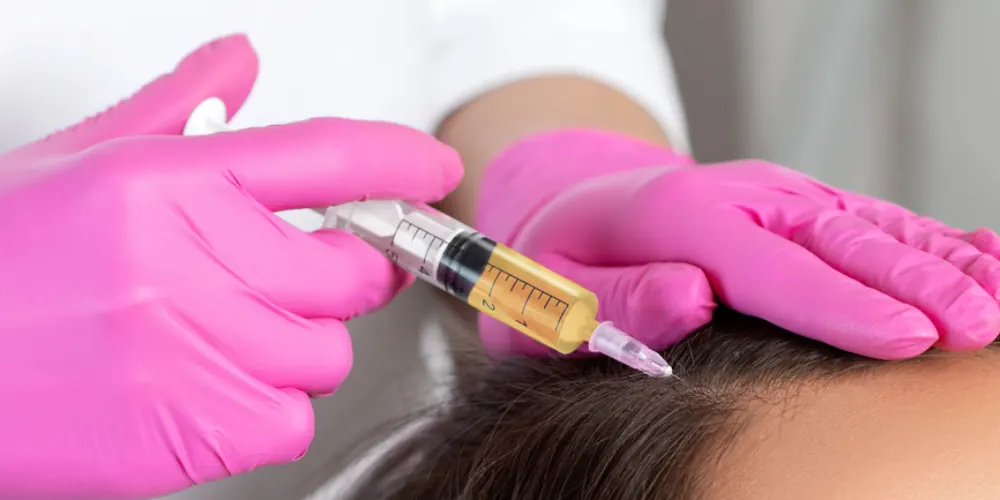
Platelet-rich plasma (PRP) is sometimes offered to selected patients with pattern hair loss. Results vary from person to person, and the evidence isn’t as strong as it is for minoxidil.
Whatever else you try, treating any thyroid problem, iron deficiency or other medical cause is still key if it’s adding to the shedding.
When Should You See a Hair Loss Specialist?
It’s a good idea to see a dermatologist if the shedding won’t stop, your parting keeps getting wider, or you can see more and more of your scalp.
Don’t wait if your hair loss comes with irregular periods, thyroid symptoms, sudden bald patches, an inflamed scalp or thinning that’s getting worse quickly.
At Dr. Dhabhai’s Skin Clinic in Jaipur, you can get a proper assessment of female hair loss, including a look at possible hormonal and scalp-related causes.
Learn more about hair loss treatment in Jaipur.
Frequently Asked Questions
Which hormone is mainly responsible for hair loss in females?
In some cases of female pattern hair loss, androgens like DHT are involved. But changes in estrogen and thyroid problems can be behind it too. No single hormone explains every case.
Can PCOS hair thinning be reversed?
It can sometimes get better with the right treatment. How much depends on the cause, how long it’s been going on, how far the follicles have shrunk and how your body responds.
Does low estrogen cause hair loss?
Falling estrogen after childbirth and during menopause can affect the hair cycle. Still, low estrogen on its own doesn’t explain every woman’s thinning.
How long does hormonal hair loss treatment take?
It depends on the diagnosis, but you’ll usually need three to six months or more before you see a clear change. Some treatments have to be continued to keep the results.
Can hair grow back after menopause?
With the right treatment, hair density can improve, especially if the thinning is caught early. If the follicles have shrunk a lot, though, regrowth may be limited.
Conclusion
Hormonal hair loss in women can come from DHT and androgen sensitivity, changing estrogen levels, thyroid problems or PCOS. Knowing which one you’re dealing with will get you much further than trying one shampoo, oil or supplement after another.
The smartest move is to find out what type of hair loss you have early and treat it the right way.
If your hair has been thinning for a while, you can book a scalp assessment at Dr. Dhabhai’s Skin Clinic in Jaipur and get a treatment plan made just for you.
PERSONAL CARE / MALVIYA NAGAR, JAIPUR
Discuss your hair and scalp concerns.
Dr. Ravindra Dhabhai can assess changes in your hair or scalp and discuss suitable next steps.
1st Floor, Plot No. 32, Above ICICI Bank, Girdhar Marg, Malviya Nagar, Jaipur, Rajasthan 302017
CONTINUE EXPLORING
Explore your care options
For patient education. Discuss diagnosis and treatment with a qualified healthcare professional.