

SKIN HEALTH / PATIENT GUIDE
How Does Laser Tattoo Removal Work? Kirby–Desai Scale, Sessions & Cost Explained
Learn how laser tattoo removal works, what the Kirby-Desai scale estimates, and how ink, skin tone, healing and sessions affect treatment costs.

PLAN YOUR TATTOO REMOVAL
Ink, skin and healing guide the plan.
A tattoo assessment helps set expectations for fading, recovery and costs.
THE SHORT ANSWER
Fading a tattoo usually takes several sessions.
Laser energy breaks ink into smaller fragments, which the body clears over time. Results and treatment risks vary with your tattoo and skin.
Not every tattoo ages well with the person wearing it. Maybe it marks a chapter you’ve closed. Maybe the lines blurred, the artist rushed it, or you simply want room for something better. Whatever the reason, wanting it gone is common, and you’re far from the first to ask how it’s done.
Before you book anything for laser tattoo removal in Jaipur, it’s worth getting the basics straight. What does the laser actually do to the ink? Why does your friend’s tattoo vanish in five visits while yours might take twelve? And what should you set aside financially?
In a nutshell: the laser fires pulses so brief they’re measured in fractions of a second. Those pulses smash the ink into tiny fragments, and your body clears a portion of them over the weeks that follow. Then you go back and repeat.
Nobody can tell you exactly how quickly it will work for you. Ink colour, depth, skin tone, placement, and any earlier attempts at removal all play a part. This guide covers each piece of the puzzle: the science, the Kirby–Desai Scale, the ALMA Q laser, session counts, healing, and cost.
What Is Laser Tattoo Removal?
Put simply, it’s a way of fading tattoo ink with light, no cutting involved.
There is a surgical option, where the inked skin is physically removed and stitched. Laser treatment takes a gentler route. The skin stays, and the light works on the ink sitting beneath it.
A tattoo needle deposits ink in the dermis, which lies under the outer layer of skin. Those ink particles are large enough that your body’s cleanup crew can’t shift them. That’s the whole reason tattoos are permanent.
The laser’s job is to make those particles small enough to move. Once broken down, immune cells can gradually carry part of the pigment away.
So the realistic goal is steady fading across several appointments. Many tattoos get very close to invisible. Some leave a ghost behind. A trustworthy doctor won’t guarantee a perfectly clean result on day one.
How Does Laser Tattoo Removal Work?
The science has a slightly intimidating name, the photoacoustic effect, but the idea is simple. Light energy gets converted into a tiny burst of physical force. Here is what happens, step by step.
Step 1: Light meets ink
The laser sends short, concentrated pulses into the tattoo. Each ink colour absorbs certain wavelengths, and when it does, energy floods into the particle in an instant.
Step 2: The particle shatters
That instant surge causes stress inside the particle and sends out a little shockwave. The particle splits into much smaller pieces.
Ink is trapped inside the skin, so it can’t be wiped or pulled out. Breaking it apart right where it sits is the only practical way to deal with it.
Step 3: Your immune system steps in
Cells called macrophages gather up the smaller fragments and move some of them out through the body’s usual channels.
This is why your tattoo keeps getting lighter for weeks after a session. The visible change isn’t finished when you walk out the door.
Step 4: Round two, three, four…
One session can’t catch every particle. Thick shading, mixed colours, and layered work nearly always leave ink for the next round.
The gap between appointments gives your skin time to recover and your body time to finish clearing what was broken up last time.
What Is the Kirby–Desai Scale for Tattoo Removal?
The Kirby–Desai Scale is a points system doctors use to forecast roughly how many laser sessions a tattoo might need.
Size tells you surprisingly little on its own. So the scale scores six things that actually change how hard a tattoo is to remove:
Factor | Why It Matters |
|---|---|
Skin type | Deeper skin tones generally call for gentler settings to protect against pigment changes. |
Tattoo location | Places with strong blood supply often clear ink differently from the hands, feet, and ankles. |
Ink colour | Black tends to be the easiest. Certain colours resist treatment. |
Amount of ink | Thick, saturated tattoos simply have more pigment to deal with. |
Scarring or tissue change | Old scarring can make the skin harder to treat. |
Layering | Cover-ups usually hide more than one layer of ink. |
Add the scores together and you get a rough guide for planning treatment.
How Accurate Is the Kirby–Desai Scale?
It’s a decent starting point, nothing more.
Plenty can shift the real outcome: what the ink is made of, how your immune system behaves, the type of laser, the settings used, and how you heal between visits.
Picture two tattoos the same size. One is a thin black script. The other is a bright, heavily shaded cover-up. The script will almost certainly fade first.
That’s why a sensible dermatologist pairs the scale with an actual examination of your skin before recommending a plan.
ALMA Q Laser Tattoo Removal: Technology and Safety
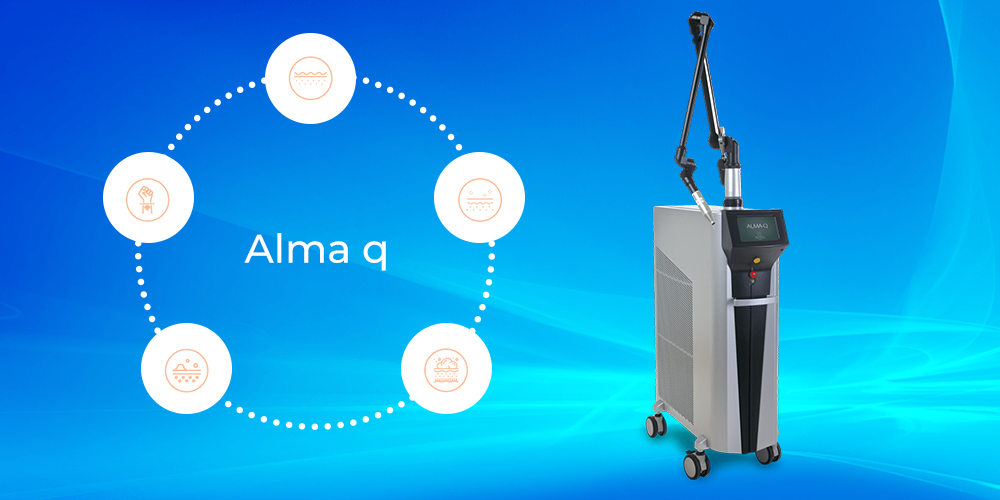
ALMA Q is a Q-switched laser platform. Dermatologists use it for a range of pigment problems, and with the right configuration, it can be used to remove tattoos.
What makes Q-switched lasers useful is speed. They pack a lot of energy into an extremely short pulse, which hits the ink hard while sending less heat into nearby skin than slower, longer-pulse lasers.
How Does ALMA Q Laser Technology Work?
ALMA Q can run at 1064 nm. That wavelength is a common choice for black and other dark inks.
Some versions also include 532 nm, which can work on certain reds, oranges, and similar warm shades.
The doctor chooses the wavelength based on your ink, your skin type, and what they find during the assessment.
Is ALMA Q Laser Tattoo Removal Safe?
Q-switched tattoo removal is a well-established treatment when a properly trained medical professional performs it with suitable settings. That said, no laser treatment is entirely free of risk.
Things you might experience:
- Redness, swelling, or tenderness that fades over time
- Blisters, scabs, or irritated skin on the surface
- Patches that look darker or lighter for a while
- Infection, if the healing skin isn’t kept clean
- Scarring or long-lasting colour change, which is uncommon
Indian skin needs a careful hand. If the settings are too strong, you can end up with post-inflammatory hyperpigmentation (darker marks) or hypopigmentation (lighter marks).
A qualified dermatologist should look at your skin type, the tattoo, and your medical history before the laser ever comes out.
How Many Sessions Are Required for Tattoo Removal?
Ask anyone who has been through it, and they’ll tell you this was their first question too: how many sessions for tattoo removal does it really take?
There’s no fixed number. A lot of professional tattoos fall somewhere between 6 and 12 sessions. Some need fewer. Some need quite a few more.
Use the table below as a general picture, not a forecast for your own tattoo.
Tattoo Type | Possible Session Range |
|---|---|
Small, lightly inked black tattoo | 3–6 sessions |
Standard professional black tattoo | 6–10 sessions |
Dense or multicoloured tattoo | 8–12+ sessions |
Layered or cover-up tattoo | 10–15+ sessions |
What Determines the Number of Sessions?
1. Ink colour: Black and navy usually respond nicely to the correct wavelength. Some greens, yellows, and blended tones are far more stubborn.
2. Tattoo age: A tattoo that’s been around for years has often lightened a bit naturally, which can make the laser’s work easier.
3. Location: Chest, back, and upper-arm tattoos can respond differently from ones on the hands, ankles, or feet.
4. Ink density: Heavier ink means more pigment to shatter and more for your body to clear.
5. Skin type: Your doctor has to strike a balance between treating the ink effectively and keeping your surrounding skin safe.
6. Layering: A cover-up brings its own extra ink, so expect more visits.
Most clinics space sessions around 6–8 weeks apart, sometimes longer, depending on how you heal and what your dermatologist recommends.
Squeezing sessions closer together rarely gets you there faster, and it can increase the chance of problems.
Laser Tattoo Removal Procedure: Step by Step
A lot of the anxiety goes away once you know what the appointment looks like.
1. You meet the dermatologist
They examine the tattoo, check your skin type, look for any scarring, and talk honestly about what you can expect. They may use a Kirby–Desai assessment to estimate the length of treatment.
2. The skin is prepped
The area is cleaned, and you’re handed protective glasses. This is also when you can talk about numbing or other ways to manage discomfort.
3. The laser goes to work
The practitioner moves the laser over the tattoo in quick pulses. Most people describe it as a rubber band snapping on the skin again and again. Straight afterwards, the ink may look white or frosted for a few minutes.
4. Aftercare begins
Your skin may be cooled down and covered with a dressing. You’ll leave with clear instructions on cleaning the area, protecting it from the sun, and spotting any warning signs.
5. You come back for follow-ups
Each time you return, the doctor checks how much the tattoo has faded and how your skin is holding up before deciding whether you’re ready for the next round.
Laser Tattoo Removal Cost in Jaipur
The laser tattoo removal cost in Jaipur shifts with tattoo size, the colours involved, the kind of laser used, and how many sessions your tattoo needs.
The ranges below are only a loose picture of per-session pricing at private clinics across India. They haven’t been verified and they aren’t official rates from any Jaipur clinic.
Tattoo Size | Illustrative Cost Per Session |
|---|---|
Very small tattoo | ₹1,500–₹3,000 |
Small tattoo | ₹3,000–₹5,000 |
Medium tattoo | ₹5,000–₹8,000 |
Large or complex tattoo | ₹8,000–₹15,000+ |
Don’t be surprised if the quote you receive sits outside these figures.
How Is Total Tattoo Removal Cost Calculated?
Your total depends mainly on how many sessions you need. Here’s a quick example:
₹4,000 per session × 8 sessions = about ₹32,000 overall
Some clinics charge separately for consultations, medicines, dressings, or follow-up checks, and those aren’t included in that figure.
Because the exact number of sessions can’t be fixed at the start, treat any early estimate as a range to budget around, not a final bill.
Colored Tattoo Removal Cost: Why Can It Be Higher?
Colour adds a layer of difficulty, because every pigment reacts to light in its own way.
Black absorbs light across a broad range of wavelengths. Coloured inks only respond to narrower bands.
Reds can respond to 532 nm. Some greens and blues need different wavelengths or a separate machine entirely.
Yellow, white, and some cosmetic inks are notoriously tough, and a few can actually darken when hit by a laser.
So colored tattoo removal cost often goes up when your tattoo needs extra sessions or more than one kind of laser.
Also keep in mind that no single ALMA Q setup handles every colour equally well. Ask during your consultation whether the device is right for your tattoo’s specific shades.
Tattoo Removal Aftercare and Recovery
What you do at home between sessions has a real effect on how you heal and how good your results look.
Stick to your dermatologist’s instructions. Usually that means keeping the area clean, leaving scabs alone, shielding it from the sun (no small task in Jaipur), and avoiding clothes or straps that rub against it.
If blisters form, let them be. Don’t pop them.
The skin’s surface often looks settled within a few days, but deeper healing and ink clearance continue for weeks underneath.
Get in touch with your clinic if the pain is getting worse instead of better, the redness is spreading, you notice pus, you run a fever, or anything else makes you think it might be infected.
Can Laser Tattoo Removal Completely Remove a Tattoo?
For some people, yes. But it can’t be promised up front.
The outcome depends on the ink’s makeup, how thick and deep it is, your skin, and how your body reacts to treatment.
Some tattoos fade beautifully but leave a soft outline or a faint shadow. And if the original tattoo caused scarring, that scar may still be there once the ink has gone.
Have a frank conversation with your doctor about what a realistic end result looks like for your tattoo.
Choosing Laser Tattoo Removal in Jaipur
When you’re weighing up clinics for laser tattoo removal in Jaipur, the cheapest offer is rarely the smartest choice. Look for medical experience and the right equipment first.
Questions to ask before you commit:
- Will a qualified dermatologist examine my tattoo?
- Which laser wavelengths can you offer?
- What steps do you take to protect Indian skin tones?
- Are follow-up visits included in the price?
You can learn more and request a consultation onDr. Dhabhai’s laser tattoo removal page.
Ultimately, a face-to-face examination is the only dependable way to get a sense of your session count and a cost you can actually plan around.
Frequently Asked Questions
Is laser tattoo removal painful?
There’s definitely some sting. Most people liken it to a rubber band being snapped against the skin over and over. Thankfully, it doesn’t last long, especially on smaller tattoos. Cooling and numbing options take the edge off, though bony areas like the ankles or ribs usually feel a little sharper.
Can a tattoo be removed in one session?
Almost never. You’ll usually see a clear difference after the first visit, but a professional tattoo holds a lot of ink, and your body needs time to clear what’s been broken down. Expect several appointments spread across months rather than a single quick fix.
Is laser tattoo removal safe for Indian skin?
It is, provided it’s done with care. Indian skin naturally carries more pigment, so the doctor must choose the right wavelength and keep settings conservative to avoid dark or light patches. Sun protection and proper aftercare between sessions are just as important as the treatment itself.
How long does laser tattoo removal take?
The laser part can be over in a few minutes for a small tattoo. Larger pieces take longer. The whole journey, however, usually runs for many months, because each session needs a gap of several weeks for your skin to heal and the ink to clear.
Does laser tattoo removal leave scars?
Most people don’t scar. The risk rises if the tattoo already had scarring, if the settings are too harsh, or if healing skin gets picked, scratched, or sunburned. Following your aftercare advice carefully is the single best thing you can do to protect your skin.
How soon after getting a tattoo can I start removal?
Wait until the tattoo has healed completely, which generally takes at least a couple of months. Lasering skin that’s still recovering from the needle can cause irritation and slow, uneven healing. Your dermatologist will check the area and tell you when it’s ready for a first session.
Can I get a new tattoo over a faded one?
Absolutely, and it’s a popular choice. A few sessions can lighten the old design enough for an artist to work over it, often with fewer visits than full removal would need. Just make sure your skin has fully healed from the last laser session before booking the new tattoo.
Do tattoo removal creams work as well as laser?
They don’t. Tattoo ink lives in the dermis, well below where any cream can reach. Most creams achieve little, and some contain strong acids that can burn the skin and cause scarring. For genuine fading, laser treatment planned by a dermatologist is the safer and more reliable route.
Can I go to the gym or swim after a session?
Take a short break. Heavy sweating, tight workout clothes, and constant rubbing can irritate freshly treated skin. Stay out of swimming pools, hot tubs, and the sea until any blisters or scabs have fully healed, since they make infection more likely. Your clinic will tell you when it’s okay to get back to it.
Who should avoid or postpone laser tattoo removal?
Doctors usually recommend waiting if you’re pregnant or breastfeeding, have an infection or rash over the tattoo, or have recently tanned. Certain medicines can make your skin more sensitive to light, so share a full list of what you take. Your dermatologist will decide if it’s safe to go ahead now.
Final Thoughts
Removing a tattoo with a laser is a patient process. The laser breaks the ink apart, and your body quietly clears it away over time.
The Kirby–Desai Scale gives you a useful early sense of what you’re dealing with, and lasers like ALMA Q can work well for the right inks.
Still, your number of sessions, how your colours will respond, and the final cost can only be pinned down in person.
If you’re thinking seriously about laser tattoo removal in Jaipur, sit down with a qualified dermatologist who can explain your options, likely results, the risks, and a cost estimate based on your own tattoo.
Book a consultation to explore your options and get a treatment estimate built around you.
PERSONAL CARE / MALVIYA NAGAR, JAIPUR
Get your tattoo assessed.
Dr. Ravindra Dhabhai can examine your skin and discuss treatment suitability, expected results and risks.
1st Floor, Plot No. 32, Above ICICI Bank, Girdhar Marg, Malviya Nagar, Jaipur, Rajasthan 302017
CONTINUE EXPLORING
Explore your care options
For patient education. Discuss diagnosis and treatment with a qualified healthcare professional.